At its core, finance is a massive pipeline. Capital providers have cash and want a return. Intermediaries and advisers move, pool, and structure that cash. Capital users such as businesses, governments, and individuals put it to work to build, grow, or operate.
The practical question is: how does money get from someone saving for the future to a company that needs funding today?
Start with understanding the end to end money pipeline
The rough map moves from providers, through financial institutions and markets, to the people and organizations that use the capital.
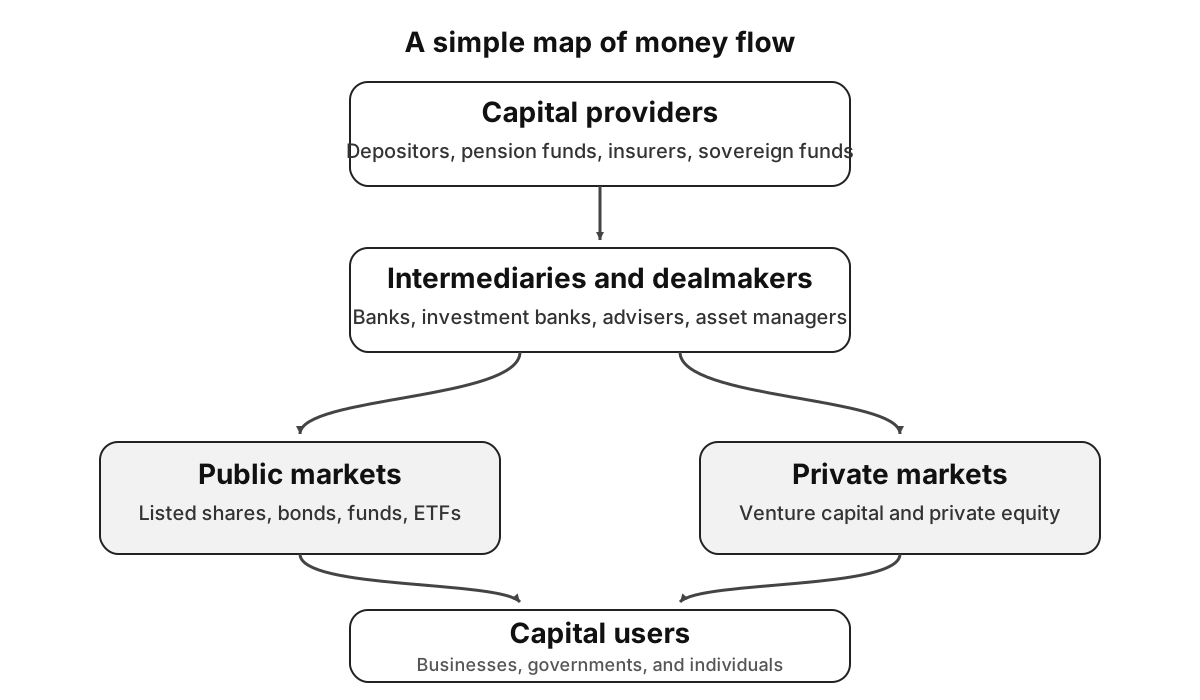 Capital moves through intermediaries or markets before it reaches businesses, governments, and individuals.
On the left are pension funds, sovereign wealth funds, and depositors. In the middle are central banks, commercial banks, investment banks, and asset managers. Capital then moves through public markets or private markets. On the right are startups, mature companies, governments, and, in some cases, individuals.
I find this map useful because it shows the direction of travel without pretending every deal follows the same route. The arrows are not an organization chart. Institutions overlap, money can skip a box, and several parties may touch the same transaction.
There are also two important corrections to the shorthand. Central banks sit around the pipeline more than inside it: they influence its operating conditions and backstop liquidity, but they do not normally route savers' money into companies. Hedge funds, mutual funds, and exchange-traded funds are investment vehicles, not public markets themselves. They invest through markets on behalf of their own investors.
The middle man
Central banks are the closest thing the system has to referees and emergency liquidity providers. They influence the price of short-term money, oversee parts of the financial system, and can provide funding when normal bank funding is under stress. For example, the Federal Reserve says its discount window supports bank liquidity and the smooth flow of credit. That is a backstop for the system, not routine growth capital for a business.
Pension funds and sovereign wealth funds are large, long-term pools of capital. Pension funds invest to meet future retirement obligations. Sovereign wealth funds invest public money under a government mandate. Their long horizons can make them natural owners of long-lived assets, although each still has return, risk, and liquidity constraints.
Insurers add another pool. They collect premiums before many claims are paid, creating what is often called float. They invest that money, but not freely: the assets need to support expected claims, regulation, and the timing of liabilities.
Commercial banks mainly connect the pipeline through debt. They take funding, including deposits, and make loans to households and businesses. A company gets capital now and promises to repay principal and interest. This is different from selling ownership, even though a loan may include covenants or collateral.
Investment banks usually play an advisory and distribution role. They help a company decide how to raise money, structure a stock or bond offering, find investors, and execute the transaction. They may commit their own balance sheet along the way, but their core job in this map is helping capital move between other parties.
Asset managers invest for pension funds, sovereign funds, insurers, and individual savers. Mutual funds and exchange-traded funds usually offer broad access to public securities. Hedge funds also pool investor capital, but tend to have more flexible strategies and tighter investor eligibility.
Public market and private market
Public markets make stocks and bonds available to a broad set of investors under disclosure and trading rules. They are generally more liquid because securities can change hands in an organized market. One nuance matters: a business receives new capital when it issues a security. Later trades mostly move that security between investors, although that secondary market still supports pricing and future fundraising.
Private investments are often hard to resell and held longer. Direct venture-capital or private-equity investors may negotiate governance rights and seek higher returns for added risk and illiquidity, but passive fund investors do not necessarily receive influence.
Venture capital usually takes minority stakes in startups. The company is early, uncertainty is high, and the investor is betting on growth rather than current cash flow. Private equity usually buys control of a more mature company, often combining investor equity with debt and taking a hands-on role in operations and governance.