Base models can do impressive work, but they are still hard to control. They may not know the details of a domain, and their context and memory are limited.
The practical question is not, "How do I make this fully autonomous?" It is, "What is the smallest capability I can add that makes the system useful?" I think about that as a ladder: a simple prompt, better prompts and chains, retrieval-augmented generation (RAG), agentic workflows, then multi-agent systems. Each step solves a different limitation and adds complexity.
Start with the prompt
The first improvements are usually prompt and context optimization. A prompt template gives repeated requests a stable structure. Zero-shot prompting is enough when the task is clear. Few-shot prompting helps when examples communicate the expected output better than another page of instructions.
For a larger task, I can chain prompts so each step has a narrower job. One might extract facts; the next uses them to answer. That is easier to inspect than a large prompt trying to reason, decide, and format everything at once.
Prompts also need tests. I want representative inputs and expected qualities, not just the example that worked while I was building. An LLM judge can help score outputs at scale, but it is part of the evaluation setup, not the final source of truth.
This is why I prefer less destructive optimization first. Templates, examples, context, and chains are easy to change and compare. Fine-tuning may be useful when those approaches are not enough, but I would not start there because the base model misses a few cases.
Add external knowledge with RAG, agentic RAG
Prompting improves how the model works with what it sees. It does not give the model missing domain knowledge. RAG addresses that limitation by retrieving relevant external data and putting it into the model's context for the current request.
RAG gives the model retrieved product documentation, procedures, or other trusted material it can use for grounding instead of relying only on training data. Retrieval alone does not guarantee that the answer follows or is supported by that material. The system still has to find useful context, pass it clearly, and test the resulting answer.
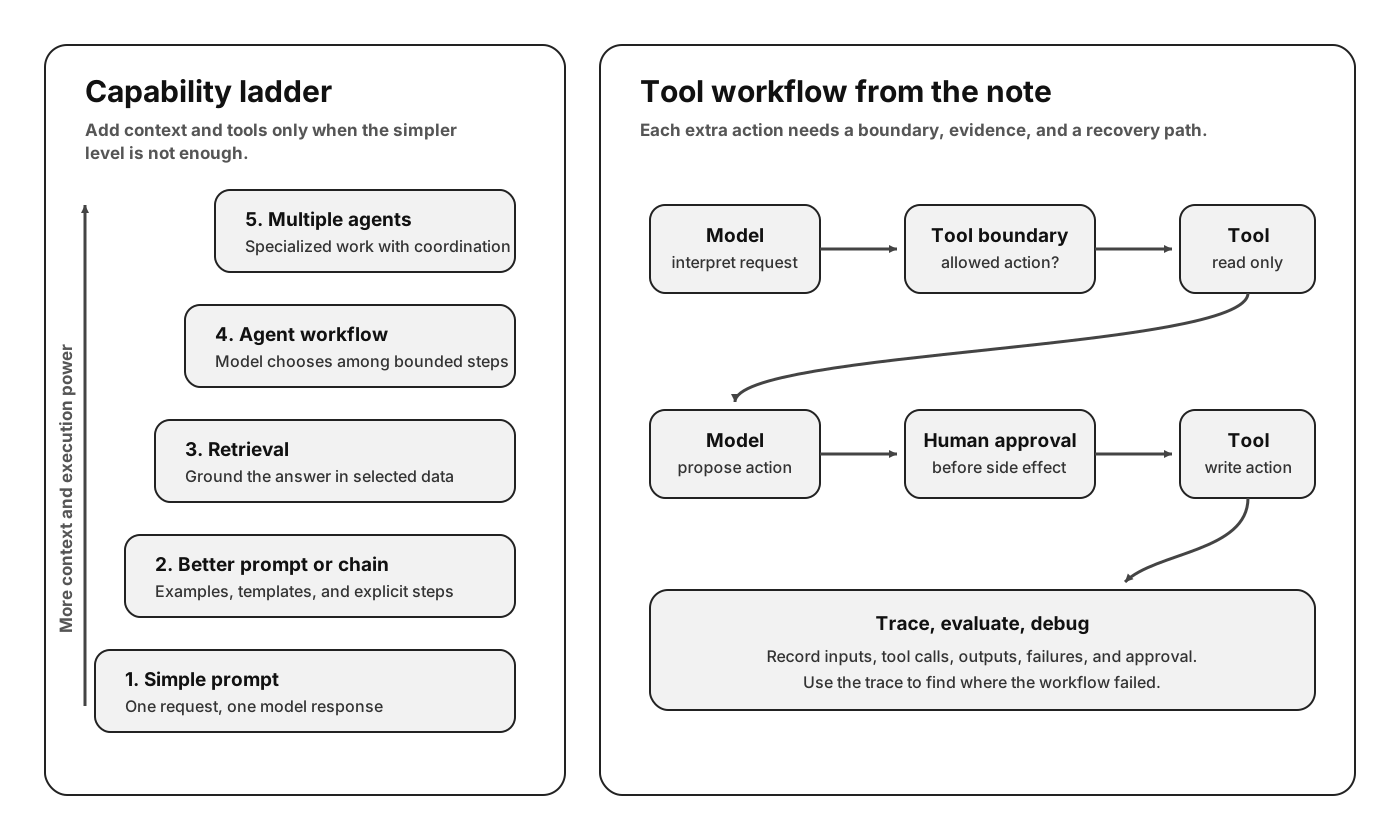 Move up the capability ladder only when the workflow also gains clear tool boundaries and evaluation.
Move to workflows when the task has multiple steps
Some requests cannot be completed by retrieving context and producing one answer. They require a sequence: the model decides what is needed, calls a tool, reads the result, and continues. The flow in practice may look like user request -> model -> tool -> model -> tool -> response.
This is where an agentic workflow becomes useful. Tools and APIs let the system act outside the model. Model Context Protocol (MCP) is one mechanism for exposing those capabilities in a consistent way. The model can select or request a tool call, while the host or client executes it under the workflow's permissions and boundaries.
Memory and context management become part of the system here. The next model call needs enough information about the request, earlier decisions, and tool results to continue correctly. Passing everything forever is not a strategy. The workflow needs to keep the relevant state while staying within the model's context limits.
Tool use is also where control before autonomy starts to matter. A weak answer is one kind of failure. A wrong API call can change data or trigger an external action. As capability grows, I want explicit boundaries, visible traces, and a clear stop condition around those actions.
Evaluate the workflow
A final response does not show how an agent reached it. To evaluate the system, I need the trace: model decisions, tool calls, tool results, and transitions between steps. That trace makes it possible to find whether a failure came from the prompt, retrieval, tool selection, or state passed to the next call.
Evaluation should also use real task cases. A clean demo rarely covers missing data, ambiguous requests, tool errors, or a long sequence that drifts. Representative cases test whether the complete workflow succeeds, while traces explain why it did or did not.
Add more agents only for strong why
Multi-agent systems sit at the top of this ladder, not the beginning. Separate agents may run work in parallel or specialize in different parts of a task. Those benefits can be real when the work divides cleanly.
They also introduce coordination. Agents need to share context, agree on handoffs, and avoid duplicating or contradicting one another. If one workflow can do the job, adding more agents creates more paths to inspect and evaluate without necessarily improving the result.
The simple role: move up one level only when the task requires it, and add the evaluation needed to see whether that level works.