Enterprise platform engineering works best when the platform team treats developers as customers and the platform as a product. A developer platform should let application teams focus on business logic while the platform handles the repeated work around infrastructure, delivery, testing, and governance. The important word is product. A pile of tools is not a platform, and a portal on top of that pile does not make it one.
The platform needs clear users, useful interfaces, and capabilities that solve common problems. Developers and testers should have one entry point where they can create a service, request an environment, find its owner, inspect delivery status, and reach logs, documentation, and quality results. A developer portal such as Backstage can provide that entry point, but it is just the interface to the platform, not the whole platform.
Core layers of a platform
The 1st layer is infrastructure automation. It provisions ready-to-use development, test, staging, and production environments with little manual work. Compute, networking, storage, databases, workload orchestration, and internal components should come from version-controlled definitions. Security controls such as network boundaries, service roles, and access policies should be built into those definitions. The result is reproducible infrastructure.
The 2nd layer is technology stack templates. These are starter kits for the stacks the organization supports. A template can include an application framework, test setup, database integration, health checks, API conventions, logging, migration scripts, and observability hooks. When someone creates a app/service, the platform can generate the repository, delivery configuration, deployment package, and basic infrastructure wiring together. The template removes boilerplate while leaving the application team in control of its code.
The 3rd layer is the delivery framework. Teams should not have to design the same pipeline for every service. A shared flow can check out code, lint it, run tests, build an artifact, scan it, deploy it to a non-production environment, and then promote it under the right approval policy. The framework can support rolling, canary, or blue-green deployment when those strategies fit the service. Teams should be able to see and extend the generated pipeline without rebuilding its secure defaults from scratch.
The 4th layer is quality assurance integration. Frontend, API, performance, and other tests should run through the same delivery path, with results available from the service page. Quality gates can make expectations visible, but they should reflect the risk and context of each system. A fixed coverage percentage is not proof of quality. A useful maturity view combines evidence such as test health, monitoring, documentation, and delivery practices, then shows teams where improvement is needed.
The 5th layer is the developer portal, the main user interface. Its service catalog answers basic questions: What exists? Who owns it? Where is it deployed? Where are its logs, alerts, pipeline, and documentation? Its templates turn supported paths into self-service actions. The portal may also show a service maturity level, but that level should guide improvement rather than become a badge teams optimize at the expense of real reliability.
The 6th layer is identity and access management. People need single sign-on and role-based access. Services need a standard way to authenticate to one another and receive only the permissions they need. The same platform may also offer customer identity capabilities, but that is a separate product concern and should not be mixed casually with internal workforce access.
These layers sit between product teams and the underlying capability providers. Interfaces include documentation, search, templates, web portals, APIs, and command-line tools. Behind them are capabilities for environments, data, messaging, identity, policy, artifact storage, delivery, and observability.
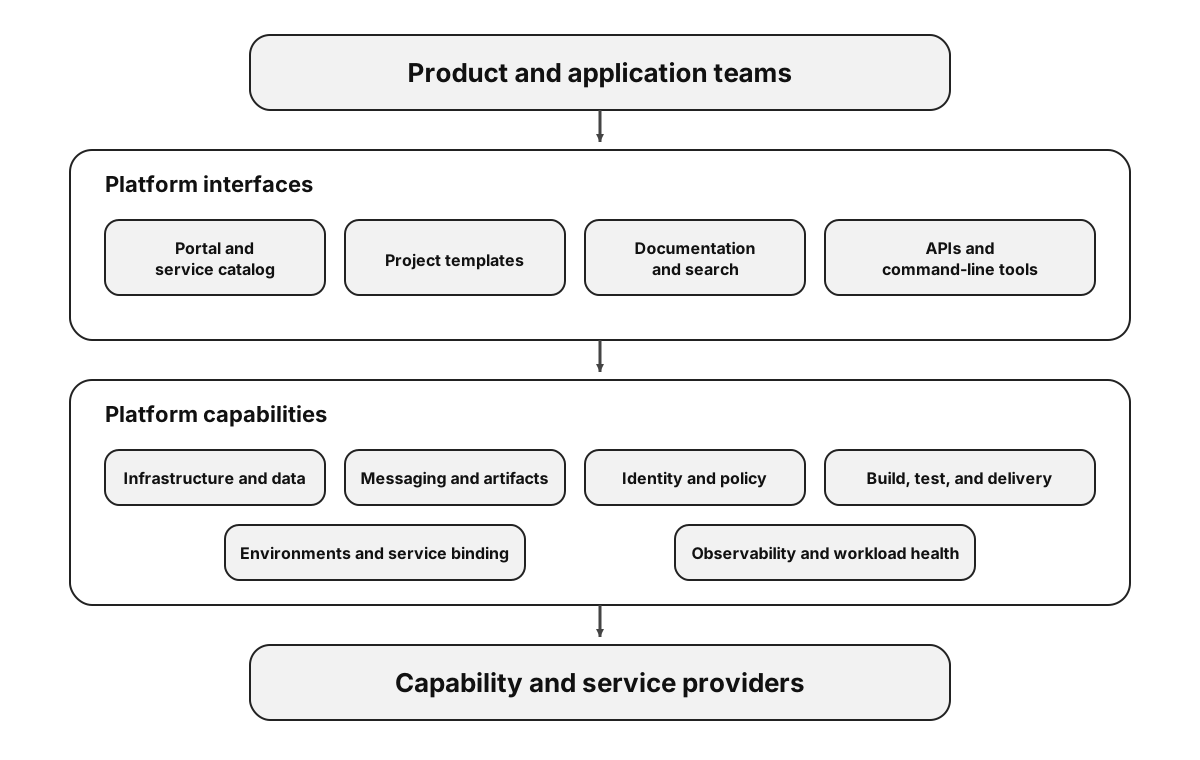 Product teams use stable interfaces to reach shared platform capabilities without operating every underlying provider.
This separation matters. Product teams should consume stable capabilities without needing to understand every provider underneath. Platform engineers should be able to change a provider without forcing every team to redesign its workflow. The portal gives people a opinionated path through the system, while the capability layer does the actual work.
Treat them as an internal product for developer
A platform succeeds when its supported path is easier than assembling an alternative. That means talking to developers and testers, watching where onboarding stalls, and improving the interfaces as carefully as the automation. A template nobody trusts, a pipeline nobody can debug, or a catalog nobody keeps current is unfinished product work.
The goal is not to hide all infrastructure. Teams still need enough visibility to operate what they own. The goal is to remove repeated setup, provide safe defaults, and make the common path clear. Build the platform around those user problems, then choose tools that provide the required capabilities. Starting with a vendor list usually produces integration work. Starting with the product experience produces a platform people can actually use.
This is also how I separate the platform from the labels around it. In DevOps, SRE, and platform engineering, I argue that the useful question is whether the organization is shortening feedback between development and operations.